Bridging user experience, system design, and product delivery

Steering Wheel Touch & Haptic Interaction System
Designing & delivering a smart trackpad system that replaces physical buttons
Eye-free usability · Accidental touch prevention · Gesture accuracy · Tactile confirmation
Overview
Modern steering wheels are overloaded with physical buttons, increasing cognitive load and reducing usability during driving.
This project explores a new interaction paradigm: replacing traditional button-based input with a unified smart trackpad system that combines gesture interaction, haptic feedback, and tactile surface design.
The solution was developed from early research to embedded prototype and later implemented in production vehicles.
My Role
-
Led end-to-end interaction design and system concept development
-
Defined gesture interaction model and mapping logic
-
Conducted human factors research and usability validation
-
Designed haptic feedback system by outputting embedded prototype.
-
Coordinated across design, engineering and stakeholders
Key Problem
How might we simplify steering wheel interaction while maintaining functionality, safety, and tactile feedback?

High Cognitive Load
Too many physical buttons

Safety Risk
Difficult to operate w/o looking

Hard to Extend New features
Limited scalability

Lack of consistency
across interaction patterns
Research
Insights • Benchmark
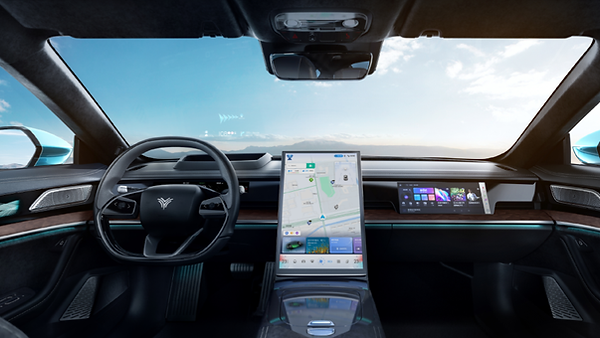
Studied steering wheel designs across automotive brands · Compared physical vs touch interaction trade-offs · Identified gaps in scalability and intuitiveness
.png)
.png)
.png)
_edited.jpg)
_edited.jpg)
 |  |  |  |
|---|---|---|---|
 |  |  |  |
 |  |
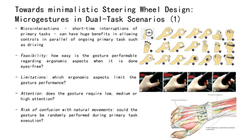
Hand reach zones on steering wheel
Gesture comfort and frequency
Interaction during driving (eyes-free scenarios)
Pressure and tactile perception
Human Factors Study
Outcome
Defined optimal gesture zones and interaction patterns for safe operation.
Exploration & Prototyping
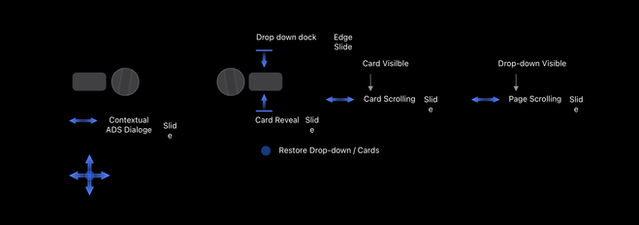
Mobile Simulation
Simulated trackpad using smartphone · Tested gesture patterns · Explored function mapping


Embedded Prototype
Built functional prototype using embedded system · Integrated gesture input with haptic feedback · Simulated real driving interaction conditions
.png)
.png)
.png)

Outcome
Before
Successfully implemented into production vehicles
Reduced interaction complexity on steering wheel
Improved driver safety and usability
Established a scalable interaction model for future features
Key Takeaways
After
Haptic feedback is critical for eyes-free interaction
Simplifying interaction does not mean reducing capability
Iterative prototyping is essential for validating new interaction paradigms
Complex systems require integration of hardware, software, and human factors
Thank you for scrolling!